Why Doesn’t My Cat Play (One Trick to Change Them!)
When people have cats as kittens, they’re super energetic, fun and they respond to whatever their owners throw at them. As they grow up, owners might still think of their cats as kittens but the small kittens learn to become highly efficient and smart creatures.
Smart and efficient are sometimes branded as lazy. Owners will buy all types of toys (not knowing which toys the cats are going to respond to best) and maybe the cats check it out for 5 minutes but in the end, the toy is left on the ground, neglected. After a period of time, many people might have the same thought – maybe they’re just not interested in playing anymore.
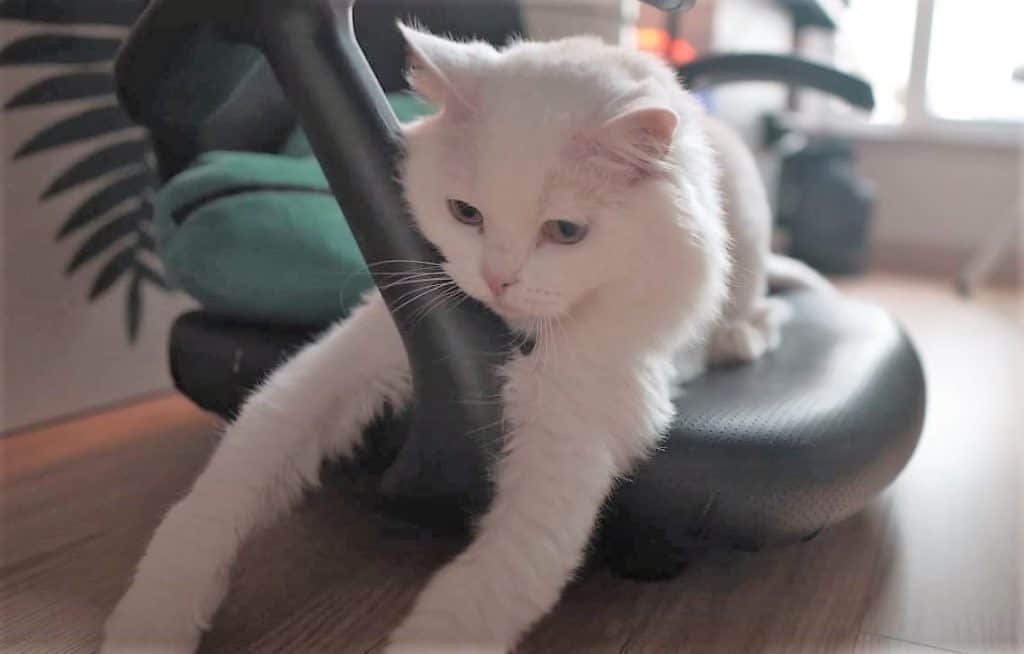
The cats grow in size and the owners complain that they’re being lazy and they ask the question:
Why doesn’t my cat play? There are 3 main reasons why a cat might not be interested in playing. The first is health and stress issues in which the cats are not comfortable moving around. Second, the way most people think about “play” and how cat likes to “play” is different. Lastly, the toys or items that owners purchase for their cats don’t fit in with how they like to “play”.
What people should understand about their lovable feline friends is that they’re predators. And what do predators do? They hunt and this is the part that we as cat owners should take into every playtime.
Make Sure Your Cat Are Able To “Play”
While it might be the most obvious thing, sometimes illness and stress can go unnoticed. A cat that has lost its appetite to eat or play is sometimes a sick or injured cat. If the things below don’t spark their predator drive or play mode then it’s likely a health issue.
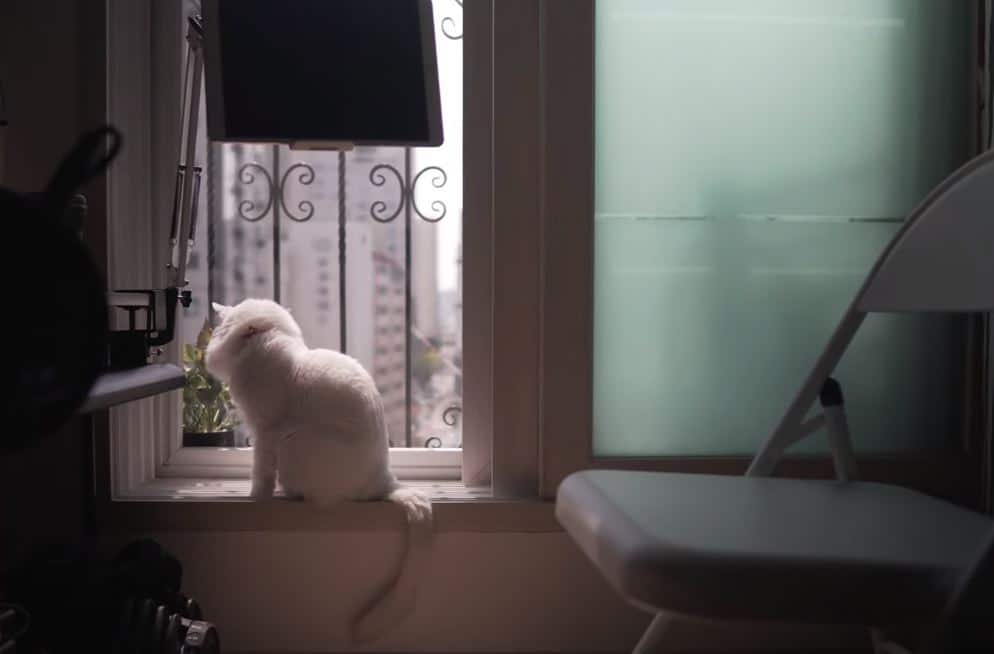
Even a very fat cat will try to swat at things in the air, even though it might not have the energy to run around. If your cat isn’t responding to any attempts at play then it’s likely a good idea to bring them to the vet to check out if everything is alright physically.
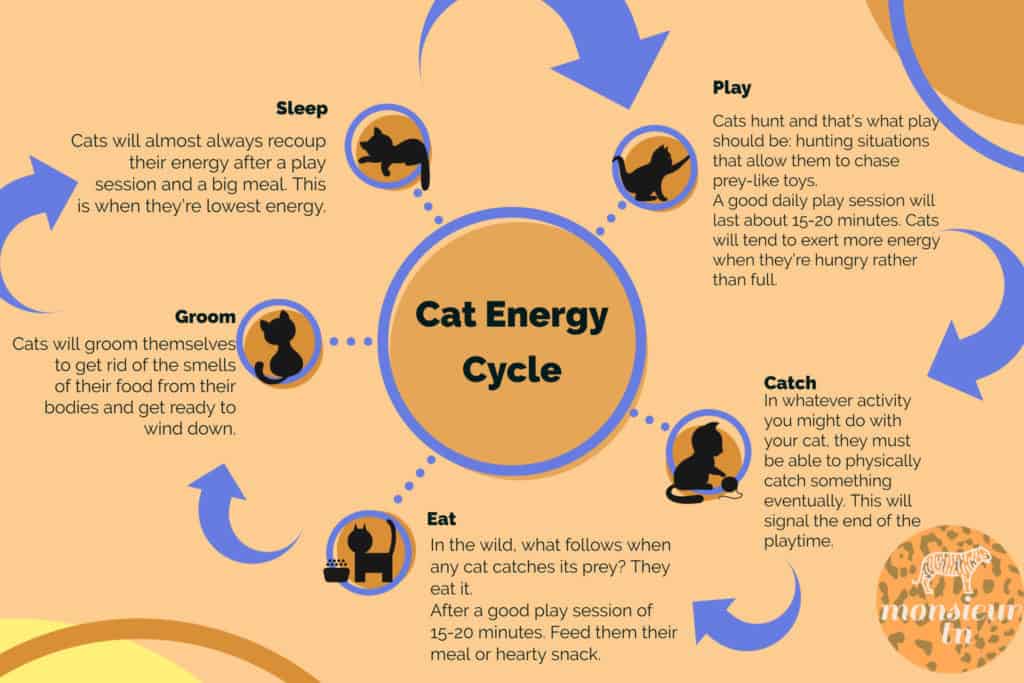
Other than that, making sure they have a good diet, schedule for mealtimes, with proper portions, is a good idea to keep their energy levels in check. Cats in the wild will always hunt before they have their meal. So typically, a cat’s energy levels are lower after a meal because that’s their recovery period (have you noticed that cats will groom and sleep after a large meal?).
A cat that’s free-feeding is likely to already be full and satiated and have less of a reason to play. As cat experts have shown, the cycle that all cats live by is: hunt, catch, kill, eat, groom, and then sleep. The more cat owners understand this – it’s easier to get what drives an adult cat.
Rekindle Your Cat’s Motivation to Play
To understand “play” and hunting behaviors – we have to think about how a cat is motivated. In the wild, they are always engaging in hunting behaviors to sharpen their skill and of course, to survive and obtain food.
The thing is that a cat indoors doesn’t really need to do any of that. They get everything given to them – sometimes they even have an unlimited source of food. Whatever the case we have to understand that a cat’s lifestyle indoors is a lot different than their lifestyle outdoors.
So to start rekindling that motivation to engage in playing or hunting behaviors we have to start thinking about how our cats obtain food in a different way as well. Always provide food for your cats only after they have “played” or have engaged in some sort of activity.
Typically, a cat will move and expend the most energy when they’re hungry. That’s when they’re the most motivated to engage in play and hunting. Therefore, it’s a good idea to start a play routine before their mealtimes.
Rethink “Playtime” With Your Cats
Going back to “playtime” itself – owners that don’t understand the above concept will likely think that their cats might not be interested in playing anymore, people might think but for the cat, it’s rather “I’m not interested in hunting that”.
Again, cats are smart and efficient. They’re going to notice if a toy is just going back and forth in a predictable manner and they’re not going to budge. If you want to engage a cat, move how a prey would move. Get into places that a small rodent or a squirrel might get into. It’s a balance, cats don’t want things to be too easy to hunt and they also don’t want it to be impossible to catch.
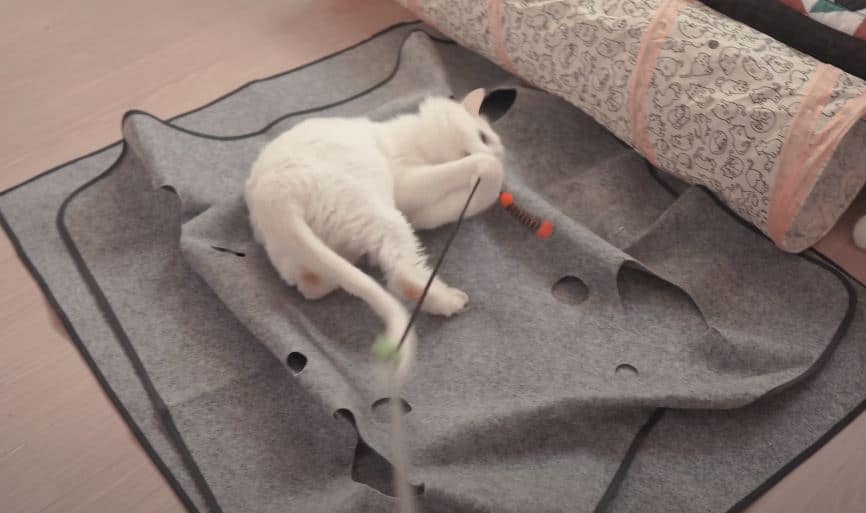
As young kittens, cats often play with themselves because everything is new to them. However, as they become adults – they require more direction.
This is why interactive toys serve a very large purpose in the toy arsenal. More than any other toy, cat owners can control where the toy goes and can vary the speed at which it moves around the home. Using unpredictable movements, hiding, burrowing is how you can spark a cat’s hunting drive.
The next thing about interactive toys is that they can actually be caught. Maybe you’ve observed how a cat might catch a feather wand toy, growl, and bring it off somewhere to be poked and taken apart some more. There’s no better feeling for a cat. In comparison, a laser will bring a cat some entertainment but they eventually realize it’s impossible to be caught and can’t that visceral feeling of taking down prey. It’s simple but often overlooked during playtime with our cats.
For another in-depth article about how to play with your cat: Cats Go Crazy for This!
After the play session, reward them with snacks/a meal and watch the cycle be completed as they groom themselves and fall asleep. Put playtime in a normal routine and watch they expect playtime and their energy levels are going to raise to match. To help you out in terms of how to fit a play schedule/routine into your daily lives, I wrote an optimal routine for cat playtime.
Toys and Items That Promote the Way Cats Like To “Play”
A lot of toys will have the cats be stationary and swat some things around but is that how cats hunt in the wild? Most toys for cats are more of a distraction and don’t provide actual value during playtime. For help on which toys and products are most effective (divided into age-groups too!), I curated a list myself that’s continually updated here: Best Toys for Indoor Cats!
I’m not saying we should play with our cats directly all the time either. There are ways to facilitate their own play with themselves or their cat brother/sisters around them.
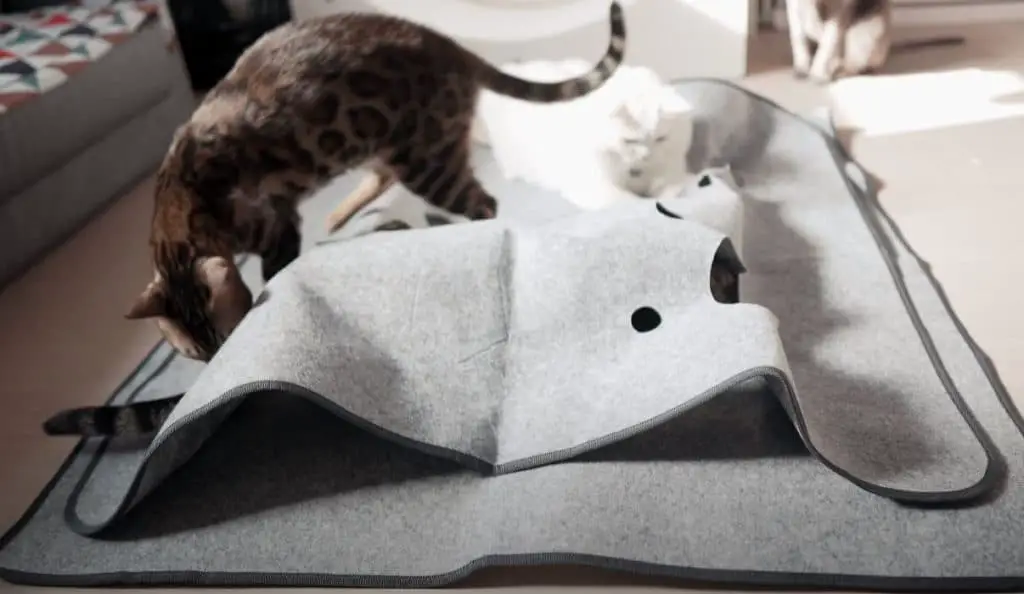
Think about how cats like to move around in the outdoors. They can run, burrow, and climb to get to the places where the prey might be. The more actions and activities that we can bring from the outdoors to the indoors the better. The toys that are very passive and provide these things to our cats are in a category of toys I like to call “play environment” type toys.
It can be as simple as a large paper bag with some holes in them or a large, used blanket that they can burrow in. So it doesn’t have to be bought either. For me, the best part of these toys is that they don’t clutter up the home with unnecessary balls or small items that can break off. This is especially important because I live in a rather small apartment here in Asia with my 4 cats.
These types of toys can be used in tandem with interactive wand toys to enhance the experience! It’s a very flexible tool that I believe that all cat owners should have!
Maybe you’re having the complete opposite experience and your cat constantly wants to play or needs attention, my article can help out with that too!